
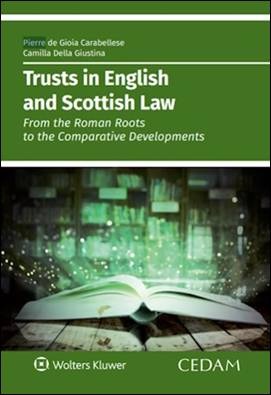
Trusts in English and Scottish Law
- Editore
- CEDAM
- Autori
- Pierre De Gioia Carabellese - Camilla Della Giustina
- Categoria
- Diritto
- Pagine
- 260
- Pubblicato
- Maggio 2026
- Codice ISBN
- 9788813392048
- Prezzo di listino
- €
36,00 - a Voi riservato
- € 34,20
DISPONIBILE - SCONTO 5% - CONSEGNA IN 24/48 ORE
Descrizione
From the Roman Roots to the Comparative Developments
Approached from a “Continental” (Civil Law) perspective, the trust is often perceived as an elusive and technically complex institution, one that can appear unfamiliar, if not opaque, to jurists and practitioners trained outside the common-law tradition. Yet the trust is neither a curiosity nor an exclusively English creation: it is a sophisticated legal technique for separating control from benefit, organising patrimonial assets, and allocating risk and responsibility across time and across persons.
This book, grounded in the historical development of the common law, demonstrates that the trust’s evolution within the United Kingdom cannot be reduced to an “English story”. Rather, it has unfolded along two parallel, though distinct, jurisdictional trajectories in England and in Scotland. Particular attention is devoted to the Scottish experience, where the trust has long operated without Equity as a separate source of law and where core trust effects are explained through concepts that resonate more naturally with civil-law thinking, including the treatment of property rights and the patrimonial consequences of fiduciary administration.
Moving from Roman-law antecedents to contemporary debates shaped by ESG duties and AI-enabled decision-making, the book amalgamates doctrinal analysis with transnational and comparative insights. Its central argument is practical as well as theoretical: in Italy, where a domestic trust remains absent notwithstanding four decades since the Hague Convention on the Law Applicable to Trusts and on their Recognition, Scotland, rather than England, may offer the more plausible and technically workable comparator for any future legislative or interpretive path towards implementing a trust consistent with civil law structures and policy constraints.